Showing posts with label amazon news. Show all posts

Wednesday, 1 February 2017

Amazon Enhanced Brand Content: A New Way To Improve Your Product Listing


By Kym Ellis

I don’t know if you noticed it yet, but Amazon have quietly introduced a brand new feature for sellers. It’s called “Enhanced Brand Content”. Enhancing your brand content – your product listing – sounds like a long awaited feature to me.
This is really exciting news for Amazon private label sellers. I’m going to explain to you what it is and why you should pay attention to it. On top of that, I decided to use our Collaborative Launch product, Jungle Stix, as a case study. So I am going to include a run-down of how we added Enhanced Content to the Jungle Stix listing. Then we will take a look at some of the results so far.
If you do anything, there is a concise run-down of the benefits and pitfalls towards the end of this post. Make sure you know those details if you’re a private label seller!

What is Enhanced Brand Content?

Well it does do what it says on the tin. It’s an enhanced way to present your product information on your listing page. This will be welcome news to your ears (or eyes), if like me you would prefer to add a little bit of visual flair and enticing narrative to your product information.
You may have previously heard of Amazon A+ Content, which is something that you used to have to sign up for, (and pay a fee), in order to get access to rich-content product descriptions.
Usually this would allow high-profile sellers to add HTML based, premium content, from the Manufacturer, for example:
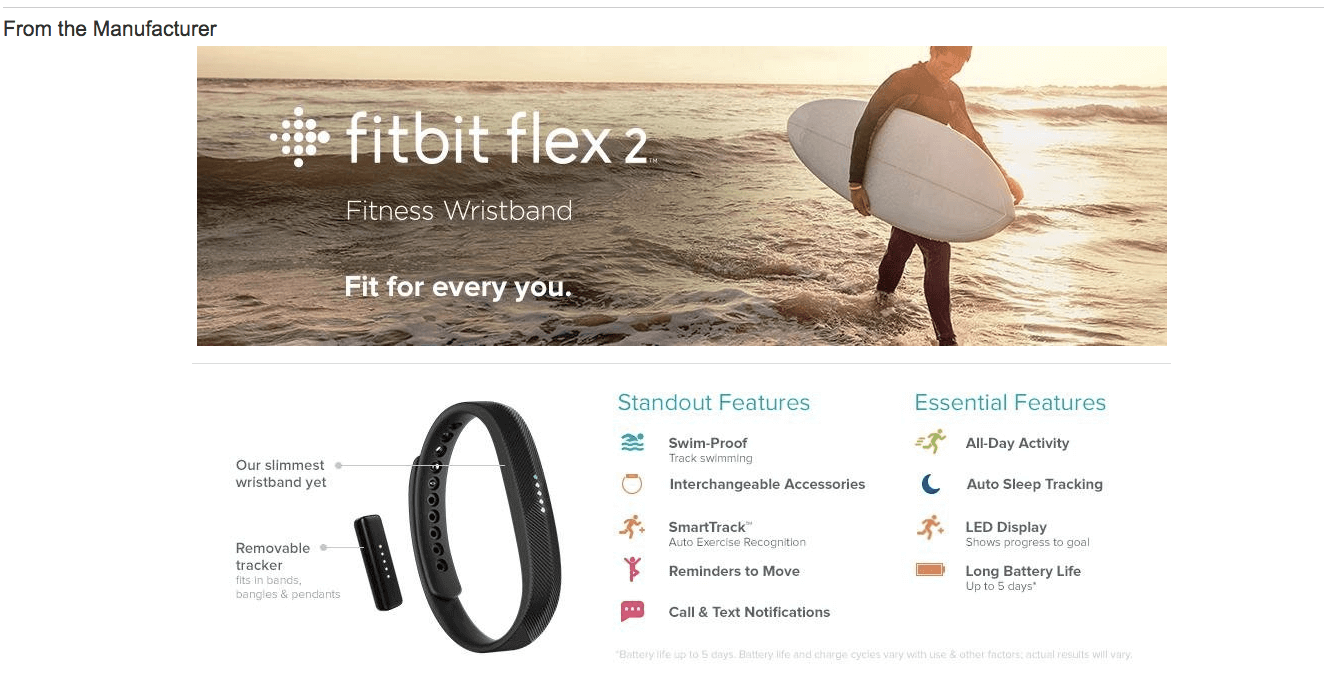
example of a+ content from manufacturer fitbit
Although Amazon is the biggest ecommerce platform that allows people like us to create a business and make loads of money, it can also be frustrating at times. Confession: I’m a control freak and I like to keep things neat and tidy. So when I first entered a description into Amazon Seller Central and saw my first glimpse of a preview, can you imagine how upset I was when I saw the text had all been squashed into one paragraph. Without any line breaks!

Enter Enhanced Brand Content (shall we call it EBC yet?!)
It’s not quite as flexible as having full custom-HTML control, as we will explore. But it does give you several easy-to-use templates, from which you can build a rich online shopping experience for your customers.
This allows you to:
  • Make your content more scannable – because we know people skim the internet
  • Add images within the description for more visual effect
  • Add subheadings, paragraphs, bold, italics, underlined text and bullet points
  • Section your content into logical chunks of information

Using Enhanced Content – 5 Simple Steps

Amazon has now opened this awesome feature up to third party sellers at no extra cost. Apparently, this is for a limited time, so it’s probably something they are testing. It’s actually happened quite low-key, but I believe it is available to all sellers who have private label products (that are under the Amazon Brand Registry).
I’m now going to walk you through the entire process, using Jungle Stix as an example. We will report on the sales metrics afterward.

Step 1 – Navigate to ‘Enhanced Brand Content’

Here’s where you can find it within Seller Central:
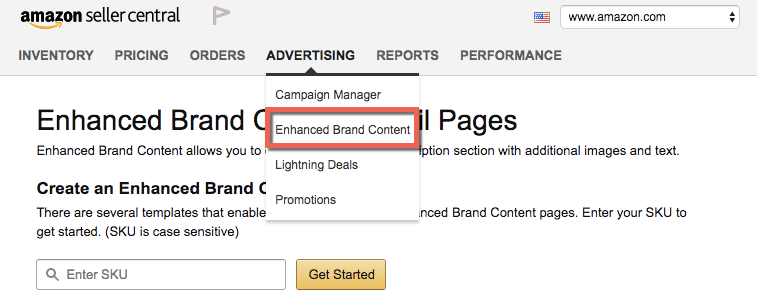
amazon enhanced brand content in seller central

Step 2 – Select a template

Easy enough. What’s next? You just enter the SKU you are looking to create Enhanced Content for and then you will be offered a choice of templates:
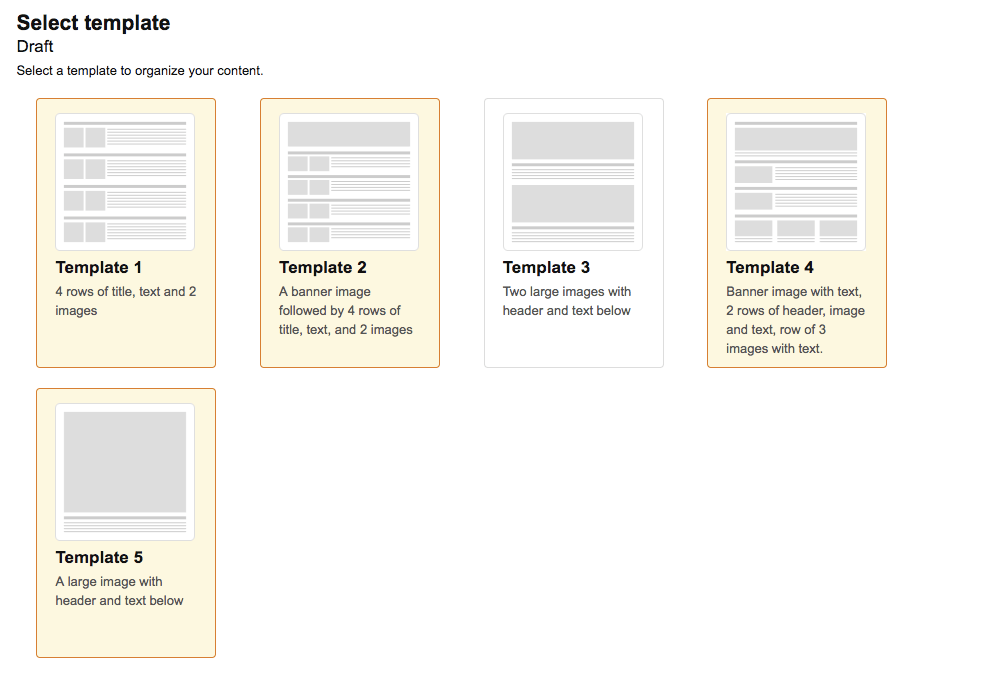
enhanced brand content templates
For Jungle Stix, I knew that I had a few sweet images and infographics to work with, so I selected Template 1. Don’t worry, if you choose the wrong one you can go back and change it at any point.
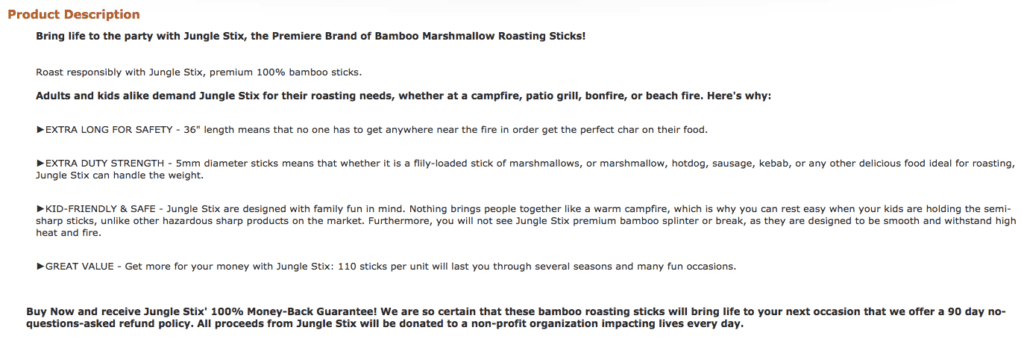
Just for reference, I want to show you what the Jungle Stix listing looked like pre-Enhanced Content:
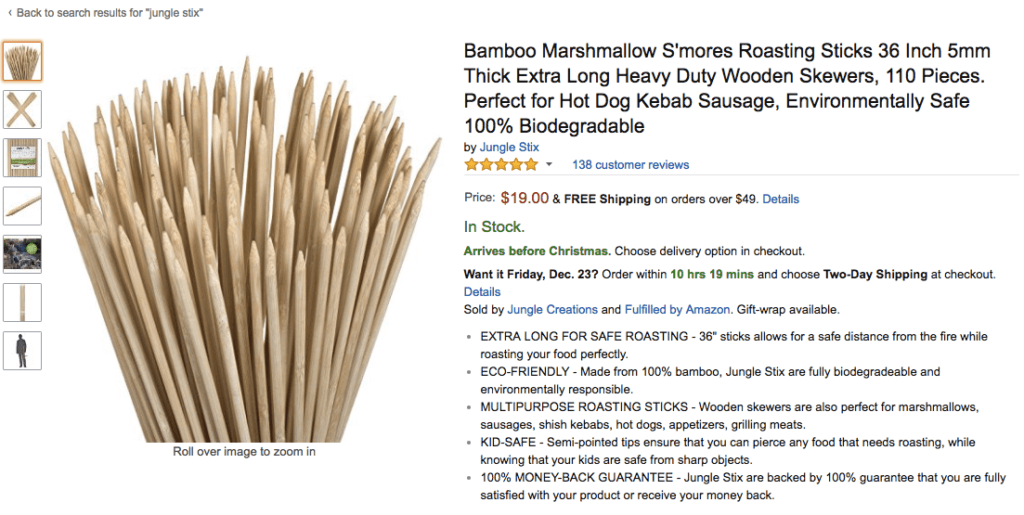
jungle stix listing before enhanced content
Jungle Stix original product description

As you can see, we have got some formatting in the description. But even so, it’s a pretty heavy portion of copy, which has a super wide line-width. (FYI, shorter line width is much better for readability, someone should let Jeff Bezos know this).

Step 3 – Add your content

I decided to attack this with our product listing in front of me, and with the folder of product images open ready to go. Take a few minutes to get yourself prepped for this.
We have spent quite a bit of time writing, optimizing and including keywords in our content and for the most part, I just want to break it up, and make it more visually appealing.
So here is where I edited the content based on the template I chose:
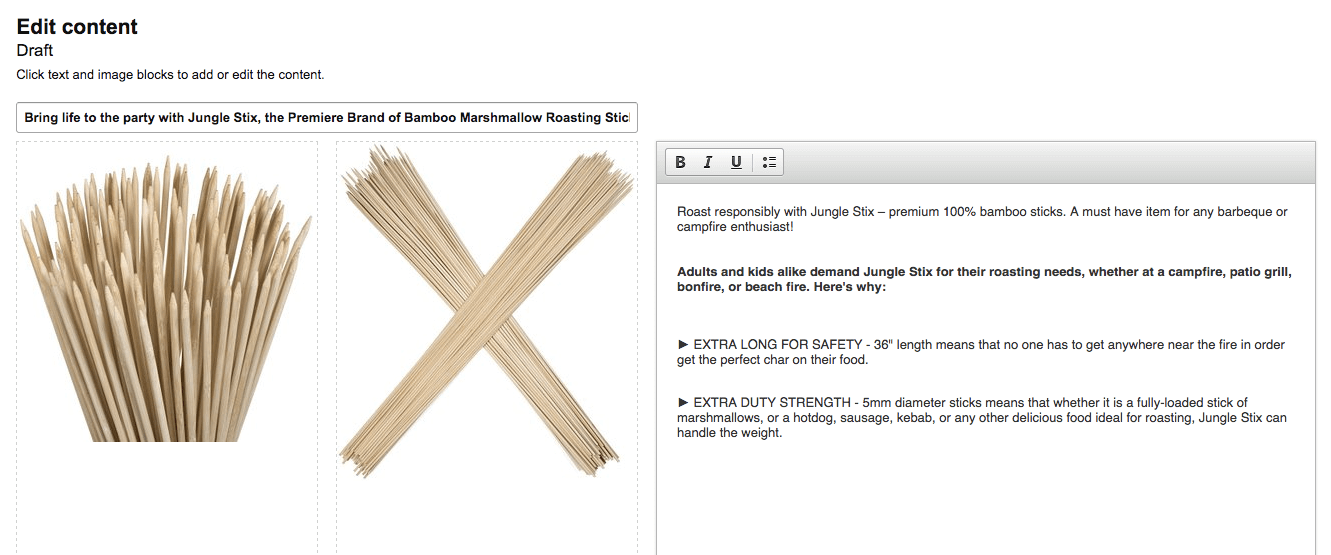
edit content fields enhanced brand content

It’s really straightforward, and as I move down the page there are more sections where I can add images and text.
Once I was happy with my content, I hit the preview button and I immediately get some messages:
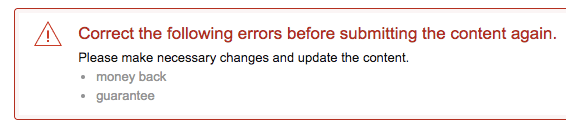
enhanced brand content errors

First of all, there are some words in there that are not allowed and it won’t let me submit my content with them included. Interestingly, these were unedited paragraphs from the original listing. Nonetheless, I reworded the copy to be in-line with the rules.

enhanced brand content report
As you can see above, you also get a useful notification if you have more space to add more content. Great!
At the moment I am happy with what I have got, but I may come back at a later date with some new lifestyle photography to spice things up.
Note: At this point I am using my existing product images which are all featured on the listing. In the future it would be worth exploring whether adding more / different types of images here would improve the performance of the product.

Step 4 – Submit for review

Once I was entirely happy and there were no errors I preview one last time:
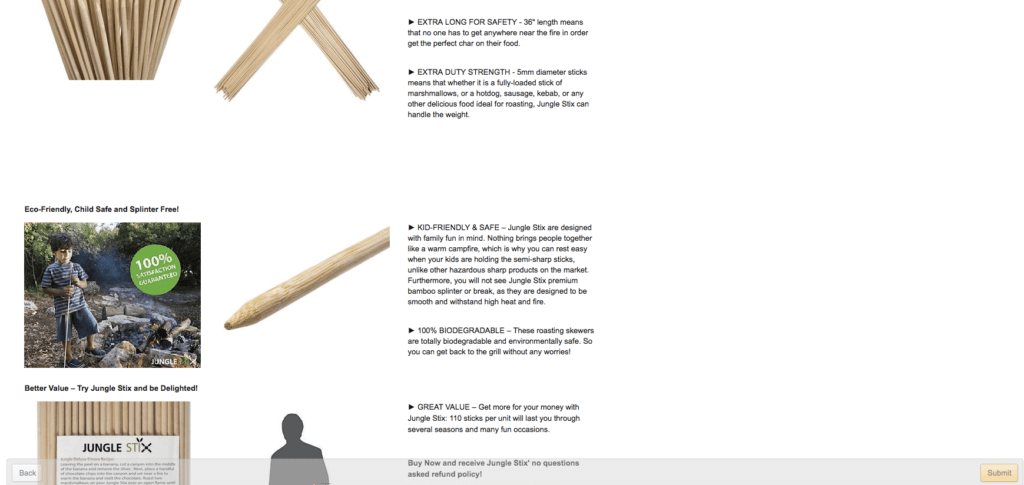
enhanced brand content final preview
Then I hit submit and it goes off to the powers that be to approve it.
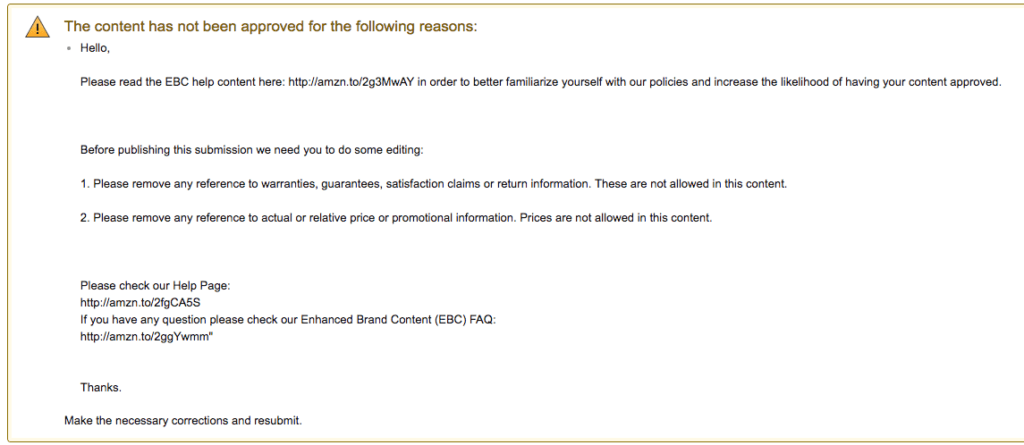
It took Amazon about a day to review the content I submitted. Guess what, it did not get approved the first time around. Here’s a screenshot of the report I received from the disapproved content:
enhanced brand content rejection

So although I managed to get around the errors report previously by removing certain words about guarantees or satisfaction, it turns out that I needed to remove all reference of this.

Getting EBC content approved

It’s likely that this content is being approved by humans at Amazon, therefore any mentions of returns information that previously got through the submission errors will be picked up.
This is a good lesson to learn. It is slightly disconcerting that I have to remove this part of the copy from my enhanced brand content, as it was in the original copy and I know that the product has been performing well with it included. Nonetheless, I remove this and replace it with some other value re-enforcements, for example:
“Buy Now and be delighted with these deluxe marshmallow roasting sticks. These bamboo roasting sticks will bring life to your next occasion and many occasions to come.”
The second issue was to remove any reference to actual or relative price or promotion. When I scanned my content back, the only culprit I could find was along the lines of “get more for your money”, or “GREAT VALUE”, with a mention of the pack size of 110 pieces. This could have been picked up due to reference to ‘relative’ price. So I tried playing around with the value offering sentence:
“PRACTICAL & FUN – Get the most out of your purchase with Jungle Stix: 110 sticks per unit will last you through several seasons and many fun occasions.”
Don’t forget that any offending words or references need to be removed from the copy and any graphics or images.

Resubmitting for approval

Once happy with my edits I resubmitted for approval. Here’s the help page from Amazon with all of the requirements and rules for Enhanced Content.
After this I actually got more feedback, that was previously not included. This time it was that one of the images was not of a high enough quality for the size it was used in this content. I simply fixed this by sourcing and uploading the most high-res version possible. Particularly for any infographics or images with words on, it can look really bad if the quality is not high enough.
Tip: Ensure you have high quality photography and infographics if you plan to use Enhanced Brand Content. Even if it gets past Amazon’s checks, blurry images will look unprofessional.

Result: The Jungle Stix Enhanced Brand Content is live (as of 11th January 2017).
Once approved, Amazon will just automatically update your listing and your shiny new content will be there for all to see.

Jungle Stix EBC

There is some white space between the top two sections, which I thought was an issue with Amazon. Upon closer inspection, it might just be that the dimensions of one of the top two images is taller. Something that I can fix myself!

Best Practice

If you are just starting out with Enhanced Brand Content, and your copy is already optimized, then you might want to follow my footsteps and just apply the same copy and images to an enhanced template. This way, you can learn from any roadblocks.
But it is also a good idea to read through the rules. Judging by the scrupulous checks and the varied time it took to get a response, there are real human beings at Amazon checking this content.
For this listing, I used the same images from the main image block, which according to the rules is not allowed. But I was able to get this through still. (Oh and yes, more exciting photography is now on the to-do list).

Step 5 – Watch the results

We definitely want to know how Enhanced Brand Content has impacted our bottom line. I managed to get the Jungle Stix content live on the 11th of January. So how did it hold up after a couple of weeks of sales?
I like to do a side-by-side comparison with two date ranges. It’s early days at the moment so I can’t draw a statistical conclusion, but I will share some data for the first few weeks so you can see the thought process behind it.

Sales velocity

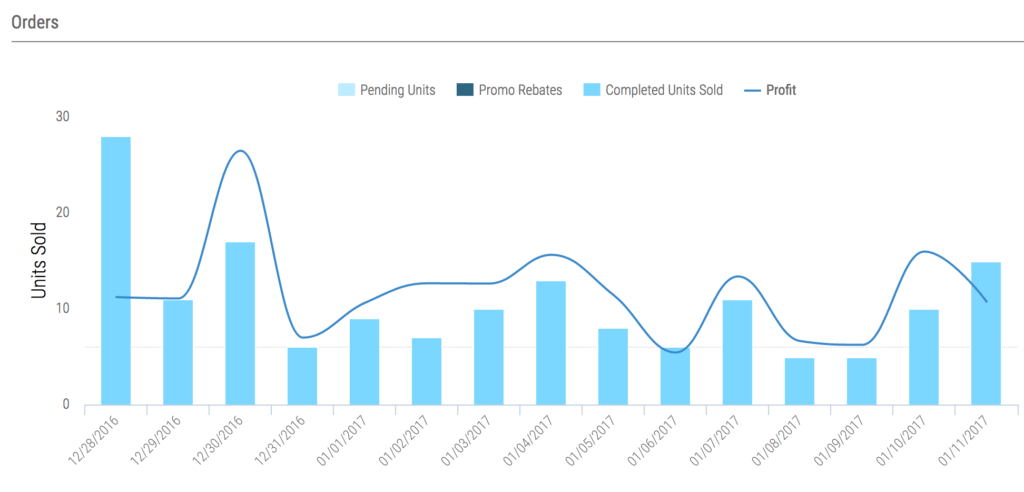
In the two week period prior to getting the content approved there were 161 total sales:
jungle stix sales two weeks prior to enhanced brand content
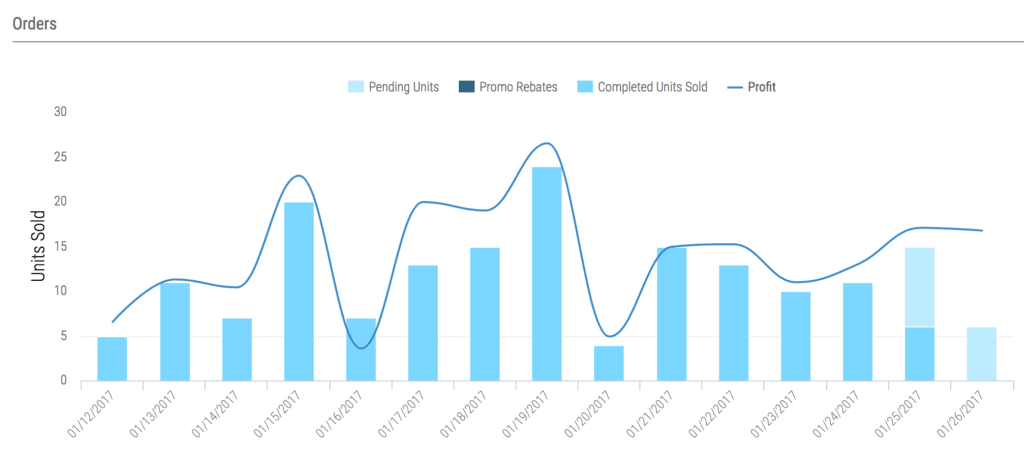
And in the two week period since approving the content there have been 176 total sales:
Jungle Stix sales two weeks after enhanced content was implemented
(This data view is from Fetcher – profit analytics software).
This shows that there has been a small increase in total sales, and you can also see some greater fluctuations day by day.

Check conversion rates

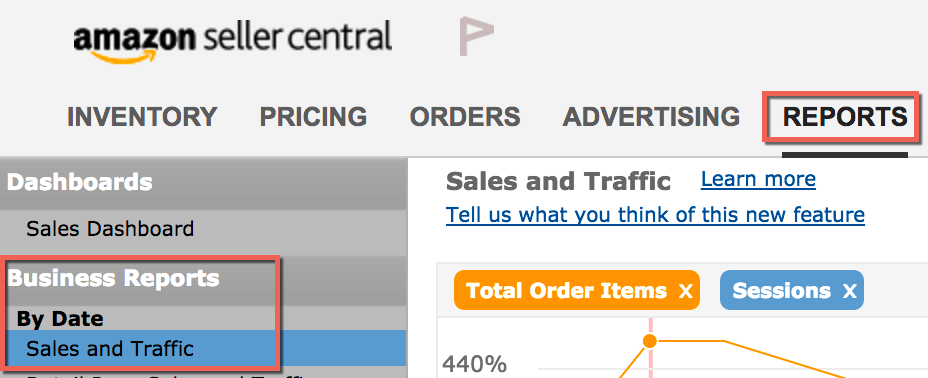
What we need to be interested in, though, is conversion rates. If we go to Reports > Business Reports > Sales and Traffic in Seller Central, we can find our conversion rate %:
amazon seller central business reports to find conversion rate
In here you can select date ranges and see your conversion rates (taking into account number of sessions/views and sales). This will be listed as ‘Order Item Session Percentage’:

conversion rates in seller central

At the moment, Seller Central can not show the full two weeks (there is always a delay of a few days). But, I can see that conversion rate has barely moved from 5.07% the week before the enhanced content went live, to 4.92% the first week it was live.
As I mentioned, this is just a couple of weeks so it’s really too soon to tell. Obviously we will want to monitor this over the coming months to ensure it’s having a good impact. So far, sales haven’t tanked, but they haven’t increased dramatically overnight, either.
If your product has been selling for a long time, you can even do a year on year comparison, which works especially well if you know you have seasonality. In the name of transparency we will keep you updated on this when we have more data.

The benefits of Enhanced Brand Content

There are some obvious benefits to being able to add more to your product listings:
  1. It appeals to different types of shoppers. Whether you scan things, read every detail or stare at images for ages, this type of content is richer, more accessible and more likely to convert a wider range of viewers. It will probably make a better first impression from the off, and prevent some people from bouncing right off your listing.
  2. Opportunity to increases sales! The important one. Improving your listing can equal more sales and more profits. Time will tell how well Enhanced Content works. But it’s safe to say that the original enhanced content A+ sellers could utilize was available for a reason.
Changing your product listing from a regular listing to an enhanced listing might be a way to improve your conversions and profits. Now you can try it for yourself right within Seller Central.

What are the pitfalls?

  • There has been some eagle-eyed suggestions that your copy in EBC will not be indexed. Therefore adding your target keywords or long-tail keywords will be ineffective when consumers are searching. (Read more here – scroll to item #3).
  • All EBC content is being approved by human beings, so you can get away with less. A lot of the content that we had disapproved was in our previous listing.
  • This means that you may need to remove copy that you previously knew was working well for you.
  • Takes a while to get approved – in my experience so far it can be anything from a day to well over a week. I actually just resubmitted some revised content for our Jungle Scout T-Shirts, because it took so long.
  • You really must have high-quality images and graphics as well as engaging content. If you don’t have these, then it’s time to get to work.

Conclusion

So that’s all on this topic for now. It will be interesting to see what Amazon does next to give sellers more creative freedom with our product listings. As an opportunity to provide a richer shopping experience and increase your profits, this is one thing I would recommend you keep on your radar for 2017.
However, as it’s new and because we are not yet sure of the impact it is having on sales, approach with some caution. Try this out with some of your products and test what works. Keep a close eye on your sales over a period of time, and make sure you keep a backup of your original description copy.

Monday, 30 January 2017

Amazon.com, Inc.'s Q4 Preview


Amazon.com, Inc. (NASDAQ:AMZN) reports on 2/2 after the close. Bank of America Merrill Lynch is slightly below on revenue and above on EPS vs. the Street. Amazon’s use of Google PLAs ads, November AWS price cuts, and weakness in select offline retailer sales (online shift?) are three key variables for the quarter. Amazon’s holiday press release data was not conclusive on 4Q spending, but highlighted several solid growth trends, including Fulfillment by Amazon (FBA) delivery growth, Alexa/Echo demand, and Amazon Business strength. While Amazon remains its top eCommerce idea for 2017, BAML is cautious into 4Q’16 results due to: 1) Historical unpredictability of 4Q; 2) Increasing revenue expectations due to offline retailer misses (share shift to online), and 3) Risk to 1Q margin outlook due to content/fulfilment ramp.  
BAML has below Street margin expectations in 2017 at revenue/GAAP profit of $35.6bn/$978mn vs. the Street at $36.0bn/$1,337mn. While BAML anticipates cuts to Street 2017 profit expectations, the firm thinks the Street will view content and fulfilment investment positively and see potential for retail margin to rebound in 2018 as recent fulfilment centers better leverage fixed costs, 3P mix increases, India investment growth slows, and streaming content costs are better absorbed (Prime Video expected to launch globally in 2017). Any commentary on the border tax or COGS deductibility implications will also be important for the stock (unlikely that Amazon provides much guidance), BAML estimates that loss of imported COGS deductibility could be more than 50% dilutive to EPS.    
As in the past, BAML thinks investors will quickly move past a near-term profitability miss if the top-line trajectory remains solid, retail market share is rapidly shifting to Amazon, and the Street is constructive on Amazon's investment initiatives. BAML views any downside on conservative 1Q profit guidance as a particular buying opportunity as core drivers (Prime, AWS, delivery infrastructure advantage) and new opportunities (SaaS, India, B2B, autos, apparel) remain intact. BAML views Amazon as the most attractive long-term risk/reward for Internet mega caps., and maintains its $1,125 PO.  

Friday, 20 January 2017

What to Expect From the Amazon Marketplace in 2017


By Karon Thackston


I’m excited to welcome back Bernie Thompson of Efficient Era. You probably remember Bernie from the first post he enlightened us with about Amazon hijacking listings and what to do if it happens to you. Today I have the pleasure of sharing with you his predictions for the future of Amazon in 2017.
“What three trends do you see shaping the Amazon marketplace in 2017 and how can sellers prepare and adapt to these trends?”

1) Amazon over-corrects in protecting the integrity of the review system

It took several years for Amazon to notice and take effective steps against the gaming of its review system. But by the end of 2016, Amazon had all guns blazing. Overall, it’s a good thing. The challenge now is in policing these much stricter rules without harming the selling community that is trying to live within them. Years ago, eBay started suspending and downgrading seller accounts in ways that were capricious and felt unavoidable for most sellers — and in doing so insured they would all take up shop on Amazon’s Marketplace. Amazon is now the company everyone is dependent on, and they too are mechanical about policing their systems. Amazon is now the one that can seem capricious — no warning, little information provided, and not a lot of statistical perspective or account history considered.
But there isn’t another marketplace to jump to in 2017. Walmart’s weeks of paperwork and hand-holding to get started on their platform is indicative of their chance of success. So sellers are going to take the brunt of any over-correction. In 2017, Amazon will struggle to get rid of sellers gaming the system (it’s still good that they’re trying), but some sellers trying to do the right thing will also be collateral damage. Given these risks everyone will be nervously trying everything they can to diversify off Amazon — and largely failing to do so as Amazon continues to dominate e-commerce in the USA and beyond.

2) Geographic Expansion

From 2011 to 2013, Amazon quickly expanded the geographic reach of their programs for 3rd party sellers. Marketplace and FBA quickly went from USA focused to globally focused — spanning North America, Europe, and Japan. However, the past few years Amazon has got stuck in a bit of a quagmire in China and India — you could say it’s like a snake digesting a panda and an elephant. Efforts in China continue, but they don’t look healthy, especially considering the headwinds against non-Chinese companies there. India continues to have difficult regulatory barriers, but looks to be a more competitive playing field. Amazon is doubling down there and doing better.
But for 2017 and beyond, Amazon seems likely to clear the blockage and begin seeking out new worlds and new civilizations. Public news reports have Amazon hunting for warehouse space in Australia. And perhaps even some countries that would seem poorly matched because of their high import duties and protective customs, such as Brazil where public reports show Amazon having one warehouse already. Sellers would be wise to jump on each of these new opportunities, keeping watch for country-specific tax and regulatory burdens that could kill the deal.

3) The Retail Empire Strikes Back

Jeff Bezos views Amazon’s Retail (1P) and Marketplace (3P) teams being separate entities which compete with each other, and either way Amazon wins. For the last 7 years, it’s been the Marketplace team that has been winning by making it easy to get started, by giving sellers control over listings, pricing, and customer communication, and by having transparent and predictable fees. But in 2016 there were signs that the Retail team wanted their ball back, with the launch of the Vendor Express program, Amazon Launchpad, and the Official Contributions (to Q&A) program.
So far, these initiatives have been very tentative, not nearly as compelling as the Marketplace features, and have had the downside of increased confusion as Retail has allowed a wider set of distributors to override the product listings of Marketplace sellers — including Brand Owners. But if Retail were to get serious, they might get rid of all the crazy, time-consuming, seller-specific negotiations over margins and marketing budgets, and instead move to a transparent pricing model like Marketplace. If they did, sellers would have two viable choices within Amazon, and everyone would benefit.
And a bonus #4:

4) Amazon’s house brands conquer more categories

AmazonBasics is a known category killer. But did you know Amazon has a nuts and coffee brand called “Happy Belly”? You won’t find Amazon’s name anywhere on the package, but yep – it’s them, just like AmazonBasics. And check out Lark & Ro for women’s dresses, Mama Bear organic baby food, and Pinzon towels and sheets. All are Amazon house brands. All of them are launched using what Amazon has learned about the market from the rest of the products selling on Amazon — including yours.
Amazon’s well-known strategy is to compete with itself and the world at every level of the business — from low-level service, to integrated marketplace, to branded product, and every layer in-between. It’s only a matter of time before Amazon moves into a nearby business. Every year, competition with the “house” will affect more product categories. The only question is how level the playing field is, and whether sellers can find ways to differentiate themselves from Amazon’s own offerings.

Wednesday, 4 January 2017

Amazon : FBA Items Shipped Worldwide Rises More Than 50% During Holiday Season

(RTTNews.com) - Amazon.com Inc. ( AMZN ) announced that Marketplace sellers on Amazon.ca achieved a record-setting one billion in sales in 2016. FBA items shipped worldwide grew more than 50 percent during the holiday season, while Prime members ordered millions of items from sellers in the Seller Fulfilled Prime program offering free two-day or next-day shipping.
"2016 was a record-breaking year in sales worldwide for sellers on Amazon. The Amazon Marketplace empowers brand owners and retailers of all sizes, many of them small businesses, to reach customers around the world," said Peter Faricy, VP for Amazon Marketplace.
Amazon noted that Sellers on Amazon.ca achieved a record-setting one billion in sales in 2016. Sellers on Amazon.ca achieved over $350 million in sales during November and December. Sellers on Amazon.ca saw record-setting units sold in a day on Cyber Monday, growing 54 percent year-over-year. FBA sales on Amazon.ca increased 100 percent over Black Friday and Cyber Monday.
The Seller Fulfilled Prime program added more than six million new items that are now Prime eligible across the U.S., U.K., France, Germany and Japan. Sellers on Amazon that reached $100K sales grew by 30 percent. Sellers worldwide have created more than 600,000 new jobs outside of Amazon.
Sellers worldwide received orders for more than 28 million items on Cyber Monday. FBA items shipped worldwide grew more than 50 percent year-over-year during the holiday season.Prime members worldwide ordered millions of items from sellers in the Seller Fulfilled Prime program offering free two-day or next-day shipping.


(SOURCE)

Sunday, 18 December 2016

U.S. Tax Considerations for Amazon FBA 

International Sellers


By Ephraim Moss and Joshua Ashman


Over the past several years, Amazon’s Fulfillment-by-Amazon (“FBA”) service has become an enormously popular business model for international merchants looking to sell products online to U.S. customers. Under the FBA model, Amazon sellers store their products in one of Amazon's dozens of fulfillment centers across the United States, which then pick, pack and ship products to customers, as well as provide customer service, including product returns.
Amazon FBA has become so popular that it has actually restricted new merchants from sending inventory to fulfillment centers during this year’s fourth quarter because of capacity concerns leading up to this year’s holiday season.
With every new business model that touches the U.S. market, there are a number of important tax issues that need be considered. The popularity of Amazon FBA has prompted both Amazon and its overseas merchants to try to fit the FBA model within the framework of the federal and state tax rules and regulations. The following are certain key U.S. federal and state tax considerations facing international merchants using Amazon’s FBA to sell products to U.S. customers.

Amazon FBA and State Taxation

From a state tax perspective, Amazon international sellers are potentially subject to two main methods of taxation – sales tax and income tax. The fundamental principle underlying a state’s right to tax transactions under both of these methods is “nexus,” which generally means the connection a taxpayer has to a particular state.
Just as state tax rates are determined on a state-by-state basis, so are the parameters of nexus. Some states focus on so-called “physical presence” (e.g., employees or property within the state), while others focus on so-called “economic presence” (e.g., a significant amount of sales within the state) or other factor methodologies. A layer of complexity is added by the fact that nexus is often defined differently for sales and income tax purposes. As a very general rule of thumb, states require a greater connection for income tax nexus than for sales tax nexus.

Sales Taxation

Most states generally take the position that third-party fulfillment centers do create sales tax nexus. As such, if a state has an Amazon FBA warehouse (more than two dozen states currently do), and your products are stored in such a warehouse, you’ll most likely be viewed as having nexus in that state and you’ll be required to register for a sales tax permit and collect and remit sales tax on sales to that state’s customers. Notable exceptions include Virginia and New York, which have specifically ruled that fulfillment centers do not create sales tax nexus in their respective states.
Managing sales tax obligations across many states can be challenging for international FBA sellers. To the taxpayer’s detriment, Amazon is known to be quite elusive about where it has fulfillment centers and where your particular product is stored at any one time. To Amazon’s credit, however, it does provide its online sellers with access to service providers and software that offer solutions that make sales tax compliance more manageable.

Income Taxation

In recent years, states have become increasingly aggressive in trying to impose taxes on online sellers. Some states, for instance, have reframed their method of taxation from an income tax into a broader “gross receipts tax” for the purpose of capturing more taxpayers within their nexus net. These states argue that while they are constitutionally restricted from imposing income taxes on businesses whose only contact with the state is soliciting sales (under a law known as P.L. 86-272), they are technically not so restricted with respect to non-income-based taxation.
In a similar vein, in the international context, some have argued that constitutional protections against income taxation with respect to limited activities are meant to apply only in the context of interstate transactions and not in the case of international transactions.
In the case of third-party fulfillment centers, Bloomberg BNA’s recently published Multistate State Tax Report for 2015 is instructive. In the report, senior state tax officials were surveyed on a variety of gray areas of state income and sales taxation, including the issue of third-party fulfillment services. While the survey rightfully disclaims that the responses should not be viewed as official state positions, they can be seen as giving a good indication as to each state’s general approach to the issues discussed.
In the survey, state officials were asked specifically whether “unrelated third parties located in your state provid[ing] fulfillment services (i.e., fill product orders from corporate-owned inventory)” was a nexus-creating activity. Most state officials answered “yes,” and only a small minority (Oklahoma, Rhode Island and Vermont) answered “no.” The answers provided by the officials on this and other issues are indicative of the overall aggressive approach by most states in this and other controversial areas of state income taxation.
In the case of Amazon FBA, unfortunately, Amazon seems to provide little direction for its online sellers regarding issues of state and local income taxation, and instead, caveats on its website that state and local income taxation obligations are solely the responsibility of the independent sellers.
Due to the complexities and uncertainties surrounding the state income tax implications of utilizing Amazon FBA, international sellers are often left with a difficult choice between taking a more conservative, but costly, approach that generally assumes nexus creation or a more aggressive, but risky, approach that generally assumes a lack of nexus under the Amazon FBA business model. Clear and official guidance by state taxing authorities would certainly be of significant help to today’s many uncertain taxpayers situated in the U.S. and abroad.

Amazon FBA and Federal Taxation

Similar to state taxes, the extent to which the U.S. government can impose federal taxes on an international merchant depends greatly on the level of connectedness that the seller has to the U.S. Whereas “nexus” is the key principle in this regard in the area of state taxation, federal tax is triggered if the activities of a foreign seller in the U.S. rise to the level of a “U.S. trade or business” or “USTOB,” and the seller’s income is effectively connected to such U.S. trade or business.
In the case that a foreign seller is resident in a country that has an income tax treaty with the U.S. (which generally trumps U.S. domestic law), a foreign seller’s U.S. business profits may be exempt from U.S. taxation so long as they are not attributable to a “permanent establishment” or “PE” in the U.S. The PE threshold is generally considered to be more taxpayer friendly than the USTOB threshold.
The parameters of USTOB and PE have been the subject of decades of litigation in U.S. courts, which has at least led to the development of some judicial precedent in this area. More recently, in the international arena, the PE concept has been the main focus area of the recent so-called Base Erosion and Profit Shifting (BEPS) project of the Organisation for Economic Co-operation and Development (OECD), with a special emphasis on today’s digital economy.
At the risk of delving too deeply into a technical analysis, suffice it to say the Amazon FBA model may present USTOB or PE risks depending on the particular terms of an agreement between Amazon and the international seller. As a rule of thumb, the more an agreement represents an agency relationship, the greater the risk generally becomes.
Currently, Amazon requires foreign online sellers to simply provide a Form W-8BEN to demonstrate their non-U.S. tax residency and avoid U.S. federal withholding tax. Interestingly, the Form W-8BEN is appropriate in cases where the foreign payee does not have income effectively connected with a USTOB. Amazon is careful, however, to include in its Amazon FBA agreements a tax indemnity clause stating that the seller acknowledges that storing products in its fulfillment centers may create tax nexus in any country, state, province or other locality in which the seller’s products are stored. It also says that it is the seller’s responsibility to fulfill any resulting tax obligations.
As with state income tax, the tax characterization of the Amazon-to-seller relationship can have significant federal tax implications from both a substantive and reporting perspective. In an uncertain tax world, an international seller’s tax risk appetite will often be the guide to its ultimate approach.


Wednesday, 23 November 2016

Amazon Plans To Create 1,000 Jobs Via New Fulfillment Center


Amazon.com, Inc. (NASDAQ:AMZN) has been heavily spending on Fulfillment by Amazon (FBA), expanding the network of its advanced fulfillment centers across the US. Today, the company announced that it is considering opening its third fulfillment center in Nevada, which will be located in North Las Vegas.

Amazon already employs full-time over 1,500 hourly associates that would on full-time basis at the two existing locations in Reno and North Las Vegas. Akash Chauhan, Amazon's VP of Operations in North America, said in a press release: “Our ability to expand Nevada operations is the result of two things: incredible customers and an outstanding workforce in the state. We are excited to expand in Nevada by growing our team, creating good jobs and partnering with members of the southern Nevada community.”
Nevada Governor Brian Sandova turned out to be delighted to be a part of the grand opening of the fulfillment center launched in Reno in April, 2015. He believes that Amazon’s plan to expand its fulfillment network in Nevada is “terrific news,” as it is creating more jobs, meeting customer needs, and providing “generous tuition assistance,” as well as a focus on military and veteran hiring. Amazon employees at the new facility covering 800,000 square feet receive, pack, and deliver large consumer products, like kayaks, patio furniture, and television.
Mayor North Las Vegas, John Lee also expressed his gratitude to Amazon for donating Kindle devices for children in elementary school. Amazon's full-time employees get competitive wages and a complete benefits package, which includes healthcare, maternity and parental leaves, stock options, as well as access to programs like Career Choice which offers tuition fee of courses on in-demand fields.

(SOURCE)